
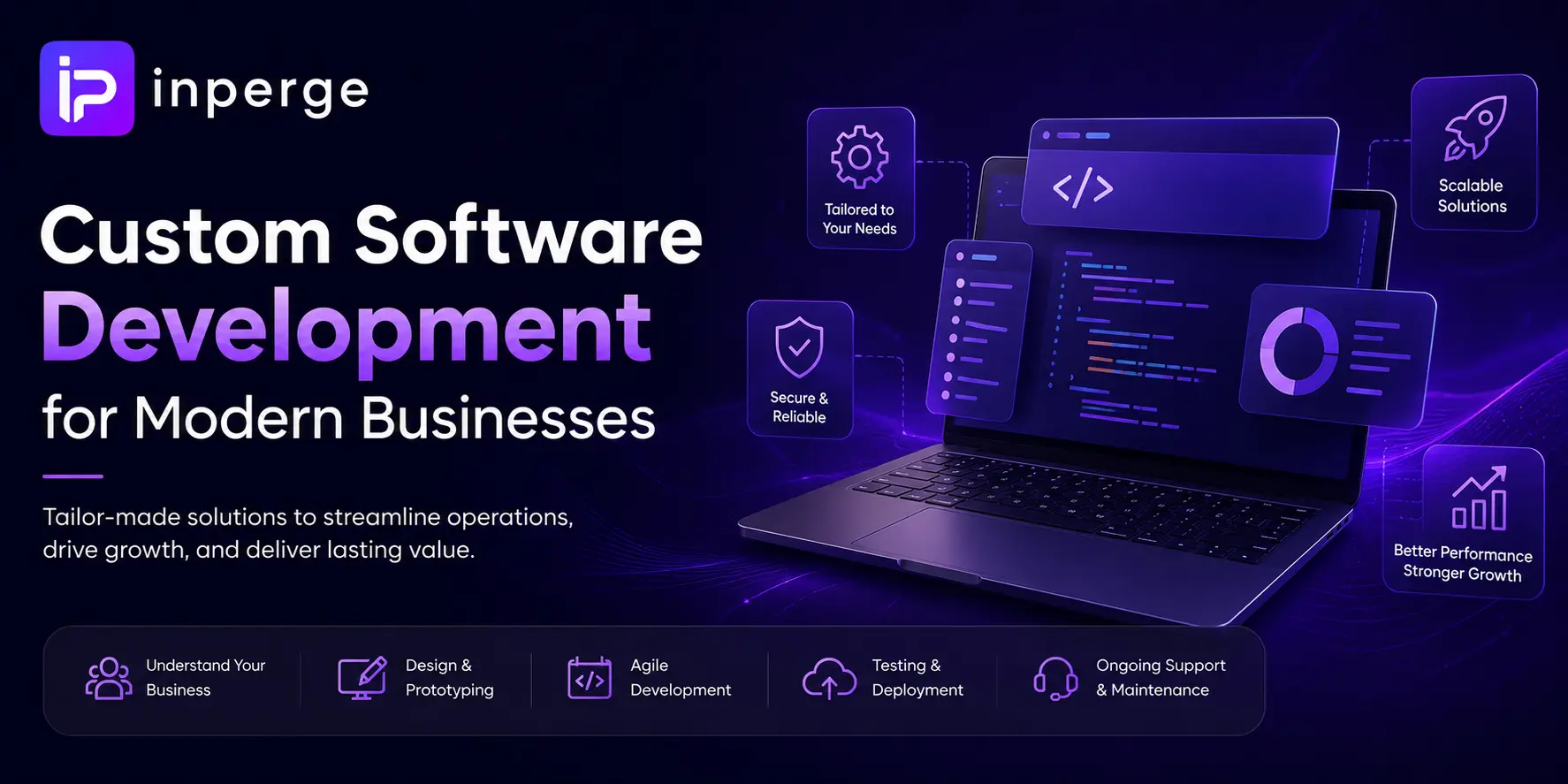
Custom Software Development for Modern Businesses
Why organizations are moving beyond off-the-shelf tools to custom software built around their workflows, security needs, and long-term growth.
Inperge Engineering
Software Team
- What Is Custom Software Development?
- Why Businesses Are Moving Beyond Off-the-Shelf Software
- Limited Customization
- Scalability Challenges
- Integration Difficulties
- Ongoing Subscription Costs
- Benefits of Custom Software Development
- Improved Operational Efficiency
- Enhanced Scalability
- Better Security
- Improved User Experience
- How Custom Software Supports Digital Transformation
- Process Automation
- Real-Time Data Access
- Improved Collaboration
- Better Decision-Making
- Industries Benefiting from Custom Software Development
- Healthcare
- Finance and FinTech
- Retail and E-Commerce
- Education
- Logistics and Supply Chain
- Emerging Trends in Custom Software Development
- Artificial Intelligence Integration
- Cloud-Native Applications
- Low-Code and Automation Platforms
- Data-Driven Applications
- When Should a Business Invest in Custom Software Development?
- Choosing the Right Development Partner
- Technical Expertise
- Industry Experience
- Agile Development Process
- Long-Term Support
- Why Custom Software Is a Long-Term Investment
- Conclusion
In today's competitive digital landscape, businesses need technology solutions that align perfectly with their operations, goals, and customer expectations. While off-the-shelf software can address basic requirements, many organizations eventually face limitations that impact productivity, scalability, and innovation.
This is where custom software development becomes a strategic investment. Instead of adapting business processes to fit generic software, companies can build solutions specifically designed around their unique requirements.
From startups creating innovative platforms to enterprises modernizing legacy systems, custom software development enables organizations to improve efficiency, streamline operations, and gain a competitive advantage in their industry.
What Is Custom Software Development?
Custom software development is the process of designing, building, deploying, and maintaining software applications tailored to a specific organization's needs. Unlike commercially available software products that serve a broad audience, custom software is created to address unique business challenges and workflows.
Examples of custom software include:
- Customer Relationship Management (CRM) Systems
- Enterprise Resource Planning (ERP) Solutions
- Inventory Management Software
- SaaS Platforms
- Customer Portals
- Mobile Applications
- Workflow Automation Systems
- Business Intelligence Dashboards
These solutions are developed with a clear understanding of business objectives, ensuring maximum value and usability.
Why Businesses Are Moving Beyond Off-the-Shelf Software
Many businesses start with ready-made software because it is readily available and often requires a lower initial investment. However, as organizations grow, these solutions can become restrictive.
Limited Customization
Generic software is built for a broad market and may not support specialized workflows or industry-specific requirements. Businesses often find themselves adjusting their operations to fit the software rather than using software that supports their processes.
Scalability Challenges
As organizations expand, they require additional features, integrations, and user capabilities. Many off-the-shelf solutions struggle to keep pace with changing business demands, leading to operational inefficiencies.
Integration Difficulties
Modern businesses rely on multiple software platforms for sales, marketing, finance, customer service, and operations. Generic applications often create data silos and integration challenges, reducing overall productivity.
Ongoing Subscription Costs
Monthly or annual licensing fees can become significant over time, especially for growing businesses with larger teams. Custom software can provide better long-term value by eliminating recurring licensing expenses.
Benefits of Custom Software Development
Improved Operational Efficiency
One of the biggest advantages of custom software development is the ability to automate repetitive tasks and streamline workflows. Organizations can reduce manual work, eliminate bottlenecks, and improve productivity across departments. Examples include automated lead management, invoice processing, approval workflows, employee onboarding, and reporting and analytics.
Enhanced Scalability
Business needs evolve continuously. Custom software is designed with future growth in mind, allowing organizations to add features and functionality as requirements change. Whether expanding into new markets or increasing operational capacity, scalable software ensures long-term flexibility.
Better Security
Cybersecurity has become a top priority for organizations worldwide. Custom software allows businesses to implement security measures tailored to their specific needs, including:
- Multi-factor authentication
- Data encryption
- Role-based access controls
- Secure API integrations
- Regulatory compliance features
These measures help protect sensitive business and customer information.
Improved User Experience
Custom applications are designed around the needs of employees, customers, and stakeholders. This results in easier navigation, faster task completion, improved customer interactions, and higher user adoption rates. A better user experience directly contributes to greater efficiency and customer satisfaction.
How Custom Software Supports Digital Transformation
Digital transformation is no longer optional for organizations seeking sustainable growth. Custom software development plays a critical role by enabling businesses to modernize operations and embrace new technologies. Key digital transformation benefits include:
Process Automation
Organizations can automate manual tasks and reduce operational inefficiencies.
Real-Time Data Access
Custom dashboards and reporting tools provide instant access to business-critical information.
Improved Collaboration
Integrated platforms enable teams to communicate and work more effectively.
Better Decision-Making
Advanced analytics and reporting capabilities support data-driven business decisions. Custom software provides the technological foundation necessary for successful digital transformation initiatives.
Industries Benefiting from Custom Software Development
Healthcare
Healthcare providers use custom software for patient management systems, telemedicine platforms, electronic medical records, and appointment scheduling.
Finance and FinTech
Financial institutions rely on custom applications for payment processing, fraud detection, risk management, and compliance monitoring.
Retail and E-Commerce
Retail businesses leverage custom software to manage inventory, customer loyalty programs, online sales, and order fulfillment.
Education
Educational institutions use custom solutions for learning management systems, student portals, virtual classrooms, and online assessments.
Logistics and Supply Chain
Logistics companies improve efficiency through fleet management systems, route optimization, real-time shipment tracking, and warehouse management solutions. Across industries, custom software enables organizations to improve operations and deliver better services.
Emerging Trends in Custom Software Development
Artificial Intelligence Integration
AI is increasingly becoming part of modern software applications. Businesses are integrating AI chatbots, predictive analytics, intelligent automation, and recommendation engines to improve efficiency and customer engagement.
Cloud-Native Applications
Cloud technologies provide greater scalability, reliability, and flexibility. Many businesses are moving away from traditional infrastructure and adopting cloud-native development strategies.
Low-Code and Automation Platforms
Organizations are using automation tools to accelerate development and improve operational agility.
Data-Driven Applications
Modern software solutions increasingly rely on real-time analytics and business intelligence. Access to actionable insights helps businesses make better decisions and identify growth opportunities.
When Should a Business Invest in Custom Software Development?
Organizations should consider custom software development when:
- Existing software no longer meets operational needs
- Teams rely heavily on manual processes
- Business growth is limited by technology constraints
- Customer expectations require personalized experiences
- Security and compliance requirements increase
- Multiple disconnected systems create inefficiencies
Addressing these challenges through custom software can significantly improve operational performance and business outcomes.
Choosing the Right Development Partner
Choosing the right development partner is essential for project success. Businesses should evaluate potential providers based on:
Technical Expertise
Ensure the development team has experience with modern technologies, cloud platforms, APIs, and software architecture.
Industry Experience
Industry-specific knowledge enables developers to understand business challenges and compliance requirements more effectively.
Agile Development Process
Agile methodologies provide transparency, flexibility, and continuous improvement throughout the project lifecycle.
Long-Term Support
Software requires ongoing maintenance, updates, and optimization. A trusted software development company can support businesses from initial planning and development through deployment and future enhancements.
Why Custom Software Is a Long-Term Investment
Unlike generic software solutions, custom software evolves alongside your business. As requirements change, organizations can add new features, improve performance, integrate emerging technologies, and expand functionality. This flexibility ensures software remains aligned with business objectives for years to come. Rather than being a short-term solution, custom software becomes a valuable business asset that supports innovation and growth.
Conclusion
Technology plays a critical role in modern business success, and organizations need solutions that support their unique goals and workflows. While off-the-shelf software may provide a temporary solution, it often lacks the flexibility, scalability, and customization required for long-term growth. Custom software development enables businesses to create tailored solutions that improve efficiency, strengthen security, enhance customer experiences, and support digital transformation initiatives. Whether you're building a SaaS platform, automating internal processes, developing a customer portal, or modernizing legacy systems, investing in custom software development can help your organization achieve sustainable growth and maintain a competitive advantage in an increasingly digital marketplace.
Building something like this?
Our team turns ideas into shipped software. Tell us about your project and we'll map out the path.
Start a conversation